

Early Fairhaven Mansions

Three homes, built within thirty years of Fairhaven’s incorporation as a town, were symbols of the growing prosperity in the developing villages on the Acushnet River.
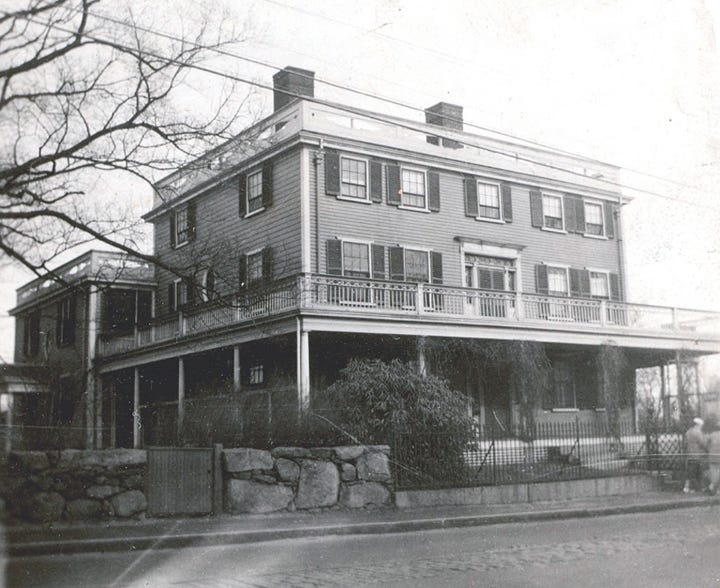
The earliest of the large homes to be built here was the eighteen-room Federal style house built by Capt. Thomas Bennett (1790-1865) overlooking Oxford Village at what’s now 199 Main Street. Bennett was a captain of packet ships that sailed on the trade route between New York and Liverpool. Built just prior to the War of 1812, the house has been called “the most pretentious dwelling in the village.”
The Bennett family, headed by Robert Bennett from the Long Plain section of Acushnet, owned much of the land on both sides of Main Street between Oxford Street and Pilgrim Avenue when the village was developing. The family’s fortunes suffered during the War of 1812, but they sold house lots between Main and Cherry streets and continued to prosper following the war. One son of Capt. Thomas Bennett, Thomas Jr. was a founder of the Wamsutta Mill in New Bedford and was referred to as “the father of the New Bedford textile industry.” A second son, Robert, born in 1829, continued to live in the Fairhaven homestead into the 1900s.
Miss Clara Bennett, the daughter of Thomas Jr., was the last member of the family to own the mansion. After she died in 1930, the house became one of the properties cared for by the non-profit Society for the Preservation of New England Antiquities (now known as Historic New England), which controlled the house until 1950. Because of the expense of the historical building’s upkeep and its distance from the majority of the Society’s other properties, the organization sold the building to a New Bedford couple for $25,000.
Since then home served first as a retirement home and now residential apartments.
It was about thirty years after Bennett built his Oxford home before anyone living to the south in Fairhaven Village built a home as noteworthy.
In 1840, the “wealthiest man in town,” whaling merchant Nathan Church (1785-1859) , build the large “Brick House” on the northeast corner of Center and Green streets, now numbered 109 Green Street. Previously he had lived at the southwest corner of Center and Middle Streets. Born in Rochester, Church made his fortune as the owner of several whaleships. He served as a director of Fairhaven‘s two banks. He spent $22,000 on the new house and it has been said that he and his son Henry personally inspected every brick that went into the construction.
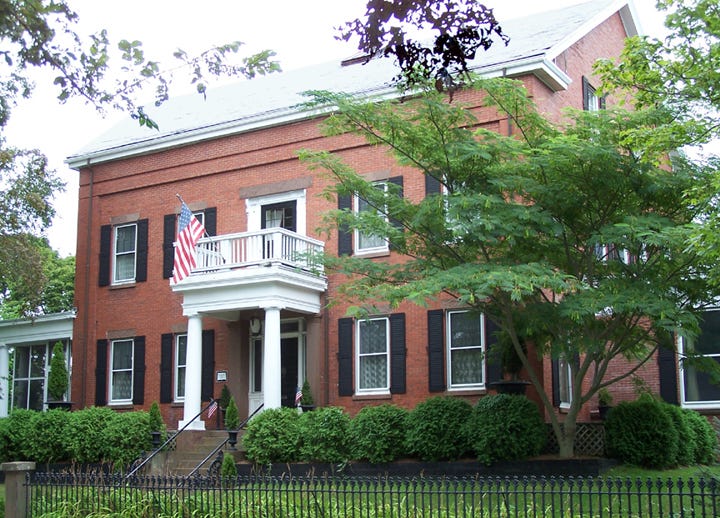
Because Church was a Quaker, the house was of a relatively austere design. Originally, the main entrance was centered on the south end of the house, facing Center Street. A later addition altered that façade.
Church died in December 1859. At the time of his death, his total assets were valued at $339,928.83. (This equals about $12.8 million in 2024 dollars.)
Roughly coinciding with Nathan Church’s death was a national financial panic and the decline of the whaling industry. The value of the “Brick House” dropped considerably in the coming years. It was sold for $10,000 in 1865 and for $6,500 two years later in 1867. The house was bought for $4000 by Walter P. Winsor in 1879.
Winsor, son of Captain Alexander Winsor, was a childhood friend of Henry H. Rogers. He entered the banking business and became the cashier and then the president of the First National Bank of New Bedford. When he purchased the “Brick House,” Winsor had lovely gardens installed. He hired horticulturalist Peter Murray to oversee the gardens. While working for Winsor, Murray bred a lovely cerise carnation which he named the Winsor Pink. In 1906, F.R. Pierson and Co., a nursery firm in Tarrytown, NY, paid $16,000 for the right to propagate the flower. The Winsor Pink was chosen by Queen Mary of the United Kingdom in 1911 as the official flower for the coronation of herself and King George V.
Since the days of Walter P. Winsor, the property’s value slowly increased, although until very recently its original value in 1840 dollars was still relatively higher than its value in modern dollars. Sharing a history similar to the Bennett mansion, the “Brick House” also served for a time as a rest home, Greenview Convalescent Home and later Center Green Nursing Home. In the 1990s, 109 Green Street became a private residence again.
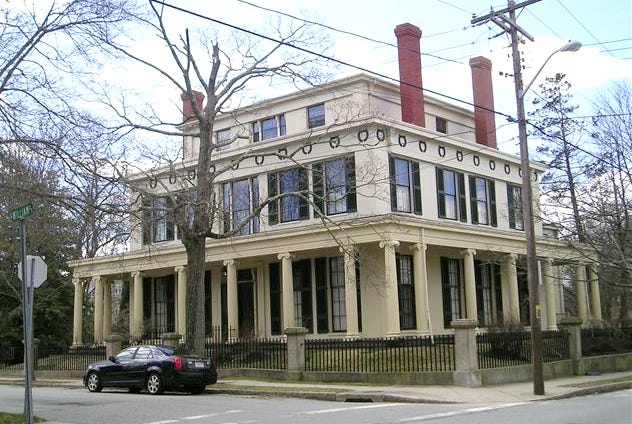
In the same year Nathan Church was building his house of brick, Ezekiel Sawin (1792-1870), his neighbor at the northwest corner of Center and Middle streets, was building a new house, too. In April of 1840, Sawin had spent $1,028 to buy a large lot at the southwest corner of William and Washington streets.
The beautiful Greek-revival mansion at 44 William Street, with its classical Ionic columns, is one of the most impressive houses to ever grace the town. (It was, perhaps, overshadowed for the brief twenty year period when Henry H. Rogers’ house stood on Fort Street.) Like Nathan Church, Ezekiel Sawin had invested in the whaling industry, having moved here from Natick, Massachusetts. He was elected as president of both of Fairhaven’s banks upon their incorporations in the early 1830s. Also like Church, Sawin moved out of the congested village west of Main Street after the Rotch family began selling lots east of the village.
Historian Thomas Tripp, writing in the 1920s, called Sawin’s house Fairhaven’s first “real mansion.” With home landscape design the latest rage, Sawin’s property, too, was laid out with flower gardens and ornamental trees as shrubs.
Sadly, Ezekiel Sawin couldn’t stay long in his house. Like many other wealthy businessmen, Sawin saw his fortune vanish in the late 1850s. The house was put up for sale, the furniture was auctioned and Sawin eventually moved back to Natick where he lived in poverty.
On March 2, 1867, Weston Howland Jr. (1815-1878) of New Bedford purchased Sawin’s mansion for $6,300.
Howland, a whale oil merchant, is credited with having been the first to refine petroleum. Howland successfully navigated the transition from whale products to petroleum and weathered the financial storms that brought ruin to others. His descendants kept ownership of the house well into the 20th century. In 1921, the mansion appeared in the silent film Down to the Sea in Ships, featuring Clara Bow in one of her earliest movie appearances. The actress stayed in the Howland home during the filming.
During the second half of the last century this house, too, was subdivided for multiple tenants. Timely restoration work has helped maintain the mansion’s original grandeur. In 1979 it was listed on the National Register of Historic Places.
Other fine, large homes were built in Fairhaven after the ones built by Bennett, Church and Sawin. But these three, built by the town’s wealthiest men, probably made more of an impact on the developing town than most that came later. Interestingly, all three were built by men who had moved here from out of town.
COPYRIGHT 2004, 2024 by Christopher J. Richard. All Rights Reserved. This was updated with additional information from the article first published in Fairhaven’s Monthly Navigator in 2004.
Your posts are such inspiring pieces of history about my hometown. Keep them coming.
I've been enjoying your pieces on Fairhaven history here, particularly this one! You have profiled three historic homes here most likely to catch the eye and stir the imagination.
Before I read pieces like yours, I assumed the Bennett house had been in inn. Its size and utilitarian looks didn't make me think mansion, but the comforts of one would have been hidden behind its walls. Perhaps Tripp thought similar things about its exterior design?
I've long admired the Nathan Church house. What was considered austere back then, looks grand and classically tasteful to me today. Passing it is one of my pleasures when visiting The Center.
Tripp was right. The Ezekiel Sawin-Weston Howland house certainly lives up to the title of mansion. Is its current color historically accurate?
As a film buff, who's passionate about silent film, I became more interested in the property when I learned of its connection to Clara Bow, one of my favorite actresses. You handled describing where her movie DOWN TO THE SEA IN SHIPS (1922) falls in her career well. It was one of her early films. According to her biographer David Stenn, she was cut from her first shot film BEYOND THE RAINBOW (1922), and it was only when DTTSIS premiered that she first appeared onscreen. BTR was later rereleased with her scenes reinserted to capitalize on her newfound popularity. So DTTSIS was both important to our area and to Bow in starting her career.